
Walking on the Camino de Santiago: Basic Logistics, Maps, Routes, and Timeframes
There are so many different ways that people opt to walk the Camino de Santiago. Each one offers its own energy, beauty, and challenges. It depends on your purpose for walking, your fitness level, and many other factors.
Below we answer some common questions about the Camino de Santiago, and offer a more detailed breakdown of the pros and cons of each route.
Common questions about the Camino de Santiago
-
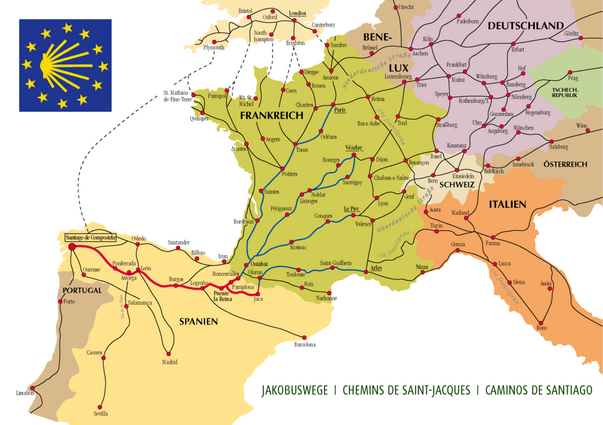
There are many different routes to walk the Camino de Santiago — from the historic Camino Frances to the coastline of the Camino del Norte. Each one offers its own energy, beauty, and challenges. Scroll down to the bottom of this page to see the pros and cons of the most popular options.
-
Our Camino de Santiago tours are not a mass-market experience; each trip is carefully curated to bring together a unique group of people. Some travelers come seeking transformation, deeper peace, or time to reflect on life and reconnect with their purpose.
Walking the Camino is a deeply personal experience, and protecting that space for reflection is our first priority. We intentionally keep our exact Camino routes private to avoid large corporate travel groups crowding the trail, which could diminish the sacred, healing atmosphere our travelers deserve.
For this reason, we don’t publicly share the specific routes we’ve chosen for our small group Camino pilgrimages — to preserve the space for authentic growth and connection.
Interested in joining one of our Camino de Santiago guided tours? Contact Us. -
Traditionally, pilgrims walked out of their front door on the Way of St. James, so the length of time was directly related to their address! For instance, if you lived in Spain, your pilgrimage there and back would be much shorter than for German pilgrims.
The Camino walking distance is going to vary with how you decide to walk. Most American pilgrims think of the Camino as “starting” in St. Jean Pied de Port on the French side of the Pyrenees, which is about 32 days of walking to reach Santiago. Very fit walkers can often walk about 30 to 35 km a day on the Camino Frances, but this is really challenging for everyone else — and guess who gets the most injuries? Fit walkers pushing themselves.
We take 12 days on our walks, as it’s the perfect amount of time to have a meaningful, even life-changing experience, without putting your life in storage or quitting your job. -
The most common modern starting point for the Camino is St. Jean Pied de Port, located on the French side of the Pyrenees. Many Spanish pilgrims skip the long (and potentially nauseating) bus ride over the Pyrenees and start in Roncesvalles or Pamplona, which is 29 days from Santiago.
Where you start your Camino is entirely up to you. To avoid the pressure of making a flight home, we recommend adding a few rest days to your plan. That way, you won’t have to rush your walk or miss out on some of the Camino’s most precious experiences. -
Biarritz Airport and Pamplona Airport are the closest airports, both about two hours from St. Jean Pied de Port, the most popular Camino de Santiago starting point. However, both airports are small and often expensive to fly into.
Most pilgrims starting their Camino walk from St. Jean fly into Barcelona or Madrid, ride the train to Pamplona, and then take the two-hour bus to St. Jean Pied de Port. Keep in mind, the bus from Pamplona only runs once a day (twice in summer), and tickets often sell out during high season.
If you miss the bus, it’s always possible to team up with other pilgrims at the bus terminal and share a taxi to the start of your Camino. Another great reason to leave ample time for your journey! -
Red Monkey guided pilgrimages include boutique accommodations, a skilled guide fluent in the local language, private vans for transport, and hidden local knowledge that only comes from walking the Camino de Santiago—a lot. You won’t find this as a novice pilgrim.
We handle all the Camino logistics, so you can focus on enjoying every step of your pilgrimage. Our prices are higher than walking independently, but we offer competitive rates compared to other guided Camino tours, which typically range from $5,000 to $8,000.
Many companies use buses to shuttle pilgrims to the “highlights” of the Camino de Santiago, but we’re dedicated to creating an authentic Camino experience. Our 12-day routes allow you to deeply enjoy one region, rather than rushing through many. Trust us — traveling slowly, at the pace of your own feet, is a phenomenal experience we rarely get in modern life.
Many people tell us they never want to travel faster again! Sometimes, seeing fewer big-name sights lets you savor more of the quiet, joyful details that make the Camino special.
We always recommend following your heart and comfort level to choose the Camino experience that’s right for you.
Pros & cons of the most popular Camino de Santiago Routes
The Camino Frances
St. Jean Pied de Port → Santiago de Compostela
There are a number of different Camino de Santiago routes. The main route that crosses Spain from St. Jean Pied de Port to Santiago de Compostela is known as the Camino Frances, because it starts in France (yes, this does make it confusing! :). Besides being historically accurate and used since Roman times, this route is fascinating, filled with the most important cathedrals, art, ancient Roman roads, and beautiful scenery. That said, it has all the guesthouses, cafes, and amenities that a pilgrim could ask for.
We recommend the Camino Frances for those seeking the true spirit and deep history of the Camino de Santiago pilgrimage.
Pros
✔ Historically rich with Roman roads, cathedrals, and art
✔ Most established route with plenty of cafes and guesthouses
✔ Best for experiencing the heart and spirit of the Camino
Cons
✖️ The majority of pilgrims walk this route
✖️ Accommodations can be competitive
Astorga to Santiago
Astorga → Santiago de Compostela
The final 200 km of the Camino marks the minimum walking needed to attain your “Compostela” or certificate of completion. Although it’s definitely cool to have your name written in Latin lettering, we believe that the more time spent walking and feeling the mysteries and beauty of the Camino, the sweeter will be your arrival in Santiago. So why go for just the minimum? Other cons are that this is the most crowded section of the trail as so many people start in Astorga for the credential.
Pros
✔ Walking through Galicia, has deep Celtic roots
✔ Galicia is beautifully green and mountainous
Cons
✖ This is the most crowded section of the trail as many people start in Astorga for the credential
✖ All those verdant hills mean it’s likely to rain
Camino del Norte
Irún → Santiago de Compostela
The Camino del Norte is primarily a walk along the breathtaking coast of Northern Spain. Although the historical accuracy is debatable, the natural beauty provides a different type of Camino experience. The most obvious difference is that the Norte route is much more strenuous than the Camino Frances, and the distance is longer. Very little of the Norte route is flat, with the trail following the ups and downs of ocean-carved cliffs. This makes for a LOT of ascent and descent each day.
Pros
✔ Breathtaking coastal scenery along Northern Spain
✔ A different, more rugged type of Camino experience
✔ Less crowded than the Camino Frances
Cons
✖ Much more strenuous: lots of steep ascents and descents
✖ Longer distance than the Camino Frances
✖ Fewer cafes, guesthouses, and water stops
✖ You’ll need to carry a heavier backpack
Camino de Santiago in France
Le Puy → Cahors (and beyond toward Spain)
Walking in France provides beautiful scenery and fabulous French home cooking, once you’re past Cahors. From Le Puy to Cahors, it’s mostly sausage and potatoes (beware vegetarians!). We don’t recommend walking in France unless you’re strong enough to carry a large pack and conversational in French. The route is 95% French natives, and second language is low compared to the Camino Frances, where most proprietors have basic English.
Pros
✔ Beautiful French countryside
✔ Fabulous home cooking (after Cahors)
Cons
✖ Heavy packs required — limited amenities
✖ Not ideal for non-French speakers — little English spoken
✖ Guesthouses, cafes, and grocery stores are few and far between
✖ Many towns are sparsely populated
✖ Frequent shop closures for siesta